



【Upcoming Exhibition】
Eyes of Things
––Biographies of Whispering Artefacts from Melanesia
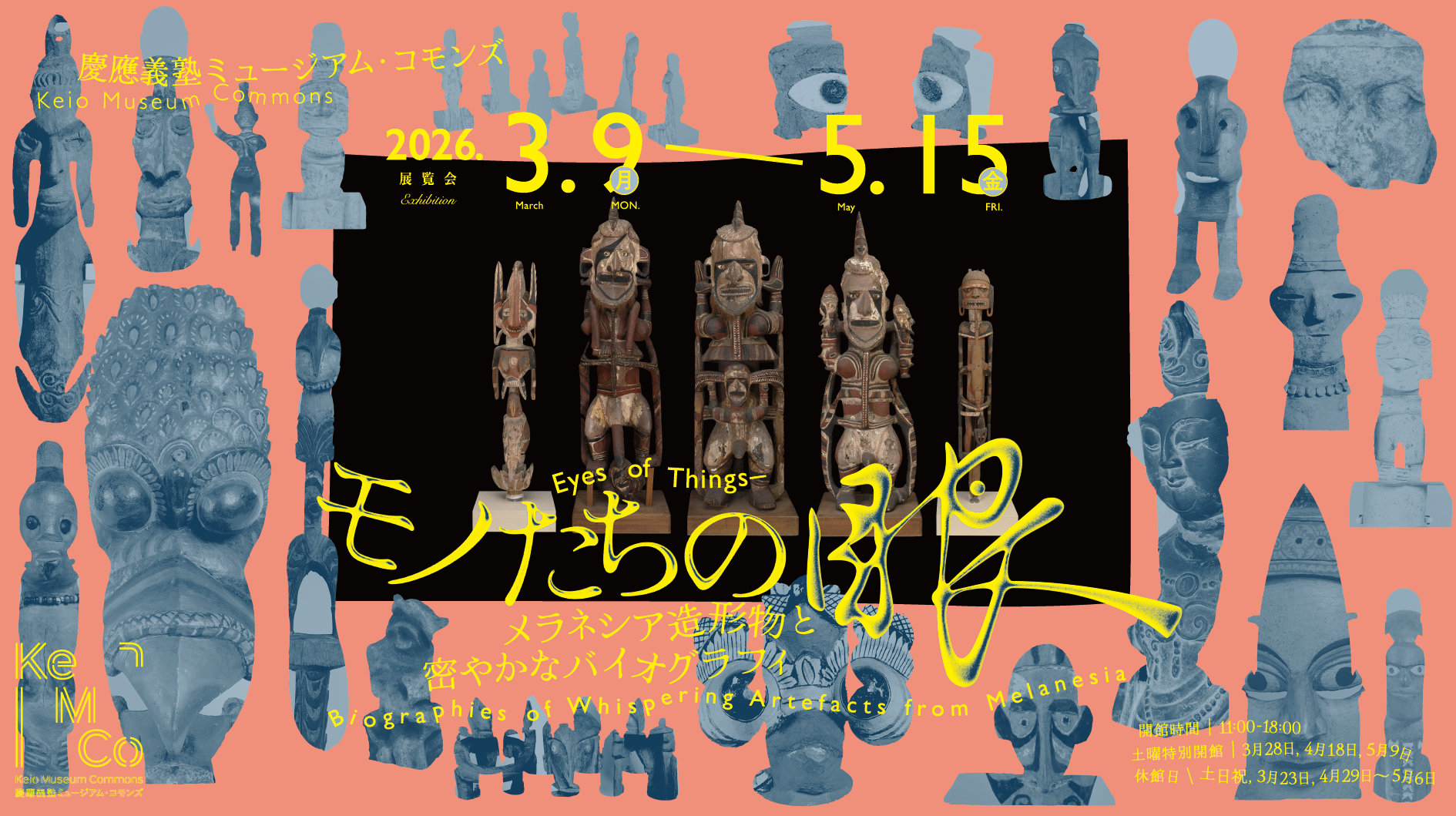
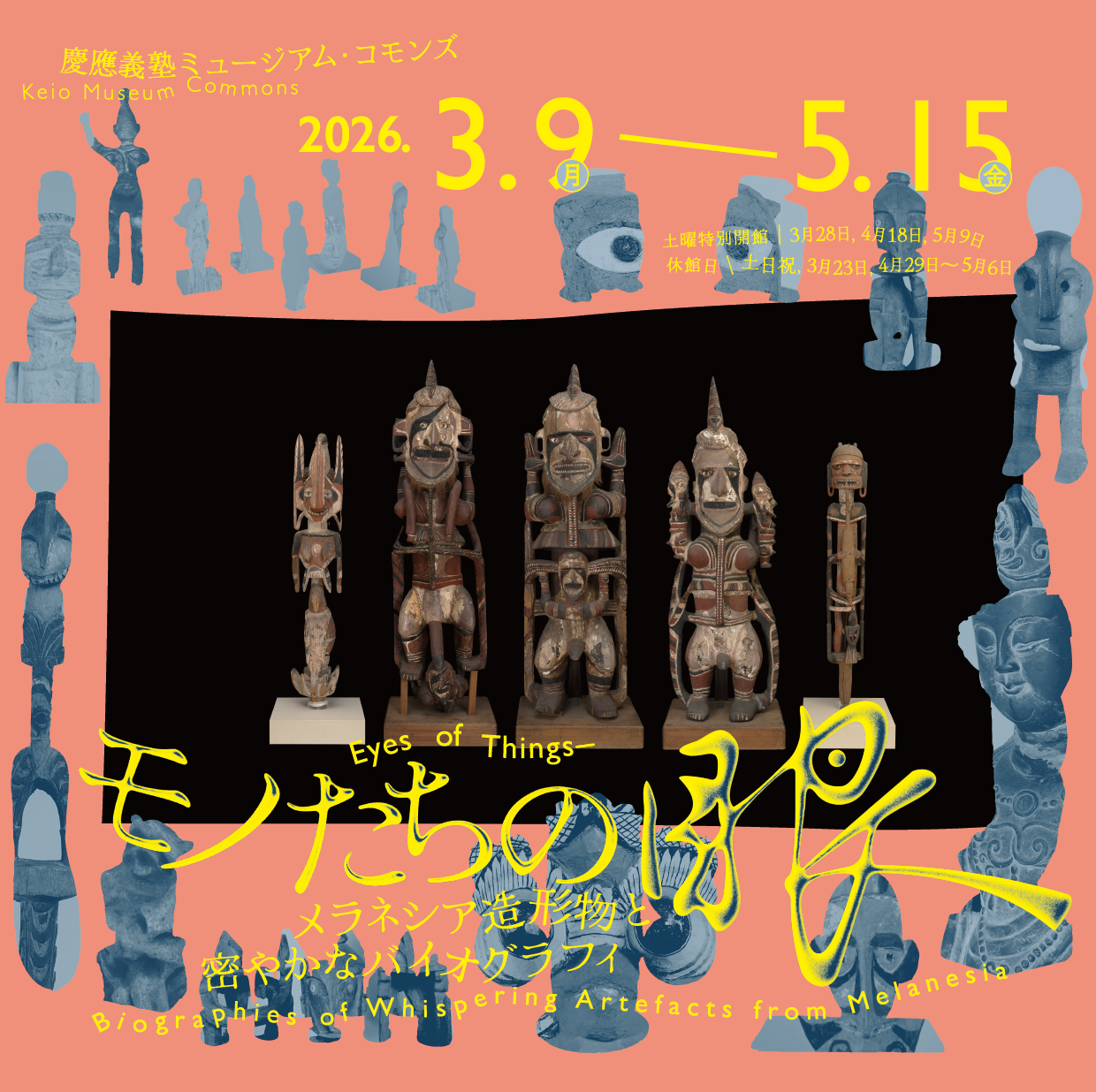
Keio Museum Commons (KeMCo) and the Department of Archaeology and Ethnology, Faculty of Letters, Keio University present an exhibition that explores the relationship between humans and ‘things’ through Melanesian artefacts. Tracing key terms from ethnology and archaeology, the exhibition brings together ancestral spirit figures, divine images, rock figurines, masks, and other works in KeMCo’s exhibition space. We invite visitors to encounter these artefacts and to reflect on their viewpoints, considering how things themselves turn their eyes towards us.
Date
March 9 (Mon.) – May 15 (Fri.), 2026 11:00 – 18:00
Closed| Saturdays, Sundays, Public Holidays, March 23 and April 29 to May 6
Special Openings|March 28, April 18 and May 9
Venue
Keio Museum Commons (Mita Campus East Annex)
Audience
Open to the public
Cost
There is no ticket fee or need to book visits in advance.
Enquiries and
bookings
Exhibition Highlights
By the time an artefact stands before us, it carries an accumulated history of events: having been made, used, negotiated, collected, displayed, resold and recontextualised over time. The trajectories of these things[s2.1]—their “biographies”—trace their relationships with humans and reveal how they moved people to act. If we shift our point of view from the human gaze to that of the artefacts themselves, what messages about society might be reflected in their eyes?
Among the collections that Keio University’s Department of Archaeology and Ethnology have preserved over the years are wooden ancestral figures known as uli and malangan. Isokichi Komine, a Japanese trader who worked around German New Guinea in the early 20th century, collected these carvings and then donated them to Keio. Since then, they have also circulated beyond the university, even being presented as art through their inclusion in exhibitions that placed them within a modern, mid-twentieth century artistic context, such as Gendai no Me—Genshi Bijutsu kara (Today’s Focus: Primitive Art Seen Through Eyes of the Present, 1960) at the National Museum of Modern Art, Tokyo.
Taking these Melanesian artefacts and their biographies as a starting point, this exhibition brings together eye-bearing things[s3.1] from ethnological and archaeological contexts in other regions, alongside works from the university’s collections that have been preserved and classified as art. Through this gathering, the exhibition opens a space to gaze and reflect as both observer and observed.
Exhibition Outline (Tentative)
Section 1: From Human Eyes to the Eyes of Things
Section 2: The Exhibition as a Device—Crossing Biographies
Section 3: The Agency of Things—Things That Move Humans / The World of Collectors
Section 4: The University as an Open Ground—Weaving Biographies
Related Events
Gallery Talk
Date: April 18 (Sat.), 14:00–15:00 (Tentative)
KeMCo will hold a talk by Professor Tohru Yamaguchi (Department of Archaeology and Ethnology), the co-curator of the exhibition.
The event is free and open to the public, but advance reservation is required (limited to the first 20 people).
Details on how to sign up and more will be announced on the KeMCo website once finalized.
*Other programs related to the exhibition will also be announced. Please check the exhibition website for the latest information.
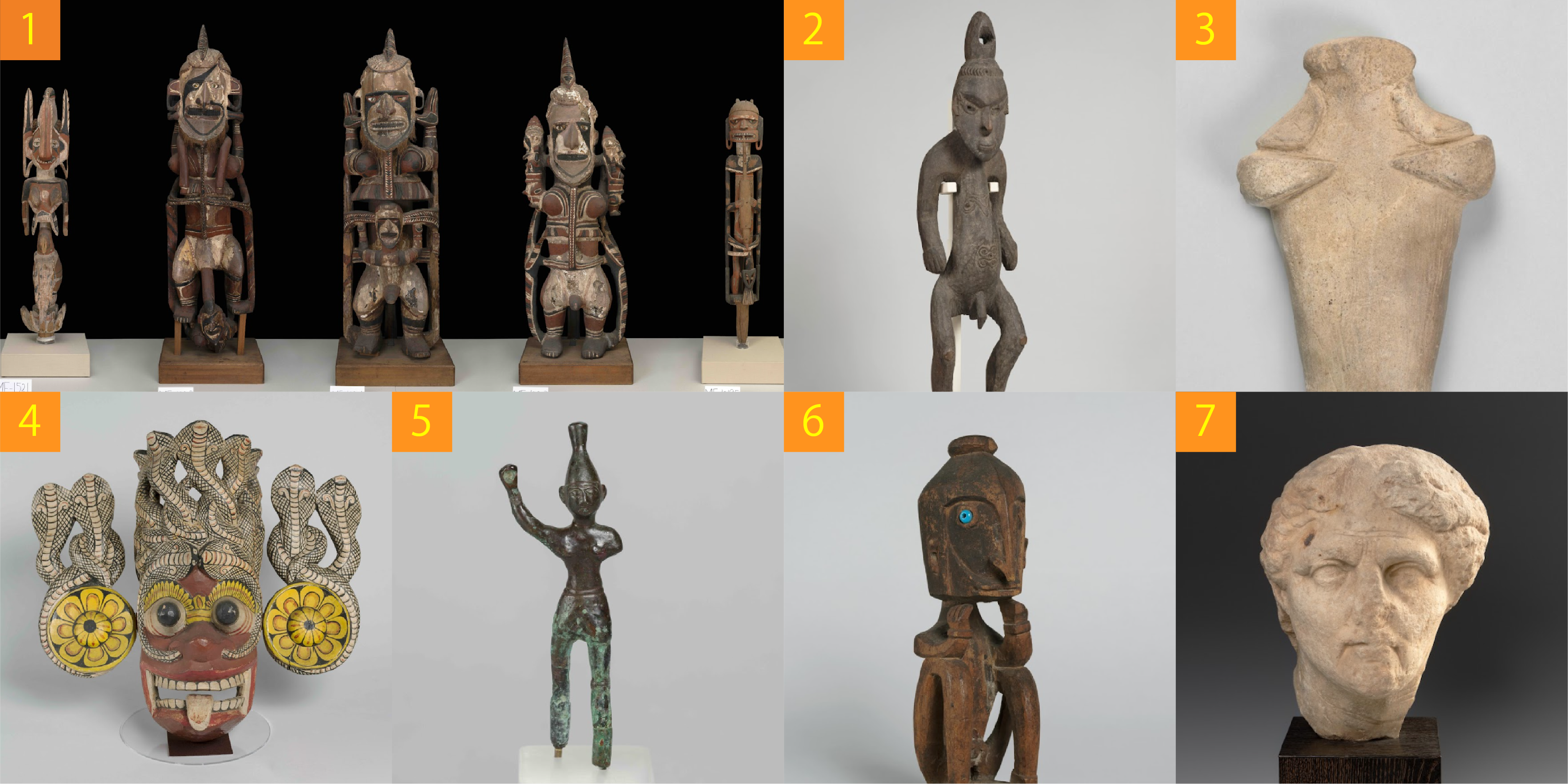
Main Exhibit Works (partial diagram)
| 1.
| Uli Statues and Malangan Sculptures (wooden ancestral spirit statues)|New Ireland Island, Bismarck Archipelago|Collected in the early 20th century |
| 2. | Wooden Figure|Sepik River Basin, New Guinea Island|Collected in the early 20th century |
| 3. | Ganguu (rock figurine)|Uchidai Site, Akita|Early Jomon Period (Important Cultural Property) |
| 4. | Mask|Sri Lanka|Collected in the early 20th century |
| 5. | Figurine of Baal|Syria|Late Bronze Age (ca.1550–1200 B.C.) |
| 6. | Korwar (ancestor figure)|Cenderwasih Bay, Northwest Coast of New Guinea Island|Collected in ca.1932 |
| 7. | Head of a Woman|ca.100 B.C.–100 A.D. |
* List order: Item name|Place of origin|Year of production/excavation/acquisition (omitted when information is not available)
* Items 1–6 are from the collection of the Department of Archaeology and Ethnology; item 7 is from the collection of Keio University.
Flyer

| Organized by: |
| Keio Museum Commons / Department of Archaeology and Ethnology, Faculty of Letters, Keio University |
| Supported by |
| Maritime Asian and Pacific Studies (the National Institute for the Humanities’ large-scale research program “Global Area Studies”), the Tokyo Metropolitan University Research Hub |
| Cooperation from: |
| Materia-Mind: Constructing a New Human Historical Science of the Co-creation of Material and Mind, Grant-in-Aid for Transformative | |
| Research Areas (A) FY2024–2028 / Center for Design of Future Symbiosis, Keio University Global Research Institute (KGRI) |
| Co-curated by: |
| Toru Yamaguchi (Professor, Department of Archaeology and Ethnology) / Kosuke Dai (Collaborative Researcher, KGRI) |
